Kontakty polskich nacjonalistów z narodowymi rewolucjonistami z Belgii zostały po raz pierwszy nawiązane w latach 90. XX wieku. Po przerwie zostały wznowione w 2009 roku, a ich efektem był udział delegacji ruchu Nation na Marszu Patriotów, a także udział wiceprezesa NOP Michała Lewandowskiego w międzynarodowej konferencji „Europa przeciwko Wall Street”.
Poniżej prezentujemy wywiad (w trzech wersjach językowych), jakiego belgijskim NR z ruchu Nation udzielił prezes Narodowego Odrodzenia Polski, Adam Gmurczyk.
*
Czy mógłbyś przedstawić naszym Czytelnikom Narodowe Odrodzenie Polski.
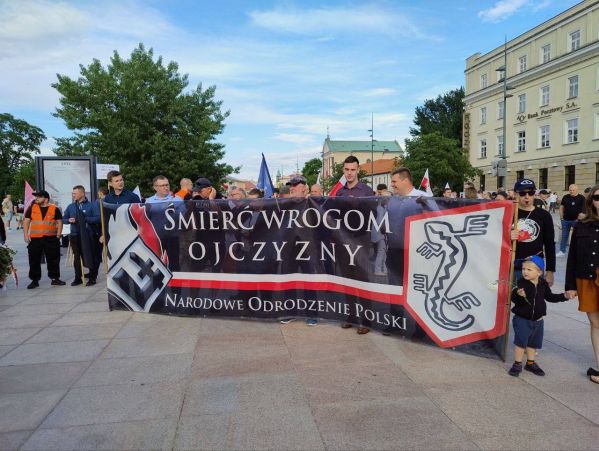
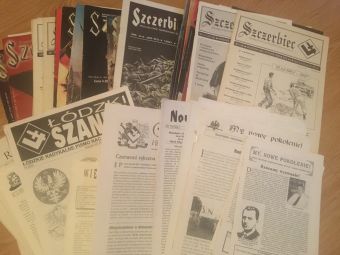
AG: Narodowe Odrodzenie Polski powstało w listopadzie 1981 r., jeszcze w Polsce pod rządami komunistycznej okupacji. Formację stworzyli ludzie młodzi, 17-21 lat, uczniowie i studenci. Kiedy w grudniu 1981 komuniści wyprowadzili czołgi na ulice, przeszliśmy do działalności podziemnej. Stworzyliśmy jedno z największych podziemnych wydawnictw książkowych (w rankingu wydawnictw od lewicy po prawicę), publikując ponad setkę książek i broszur w wielotysięcznych nakładach, wydawaliśmy kilka wysokonakładowych czasopism – na bazie kolportażu stworzyliśmy sprawny ruch. Szczególna aktywność NOP widoczna była na uniwersytetach, gdzie np. organizowaliśmy antykomunistyczne strajki – sam zresztą stałem na czele jednego z nich. Po 1989, kiedy komuniści oddali władzę, nadal działaliśmy w konwencji ruchu ideowo-politycznego. Ale zmieniły się zasady – z działalności podziemnej, przeszliśmy do działalności legalnej. Zmieniało się prawo – i dla zabezpieczenia, a niemal od początku siły liberalne i lewicowe podjęły walkę z nacjonalizmem, powołaliśmy partię Narodowe Odrodzenie Polski. Partia NOP – to nie całe Narodowe Odrodzenie Polski – ruch polityczny. Partia to wygodny dla nas element techniczny, dzięki któremu systemowi demoliberalnemu trudniej – taka specyfika polskiego prawa – zniszczyć zorganizowany nacjonalizm. A nam np. w czasach przed internetowych pozwalało korzystać przy okazji wyborów z darmowego dostępu do telewizji ogólnokrajowej, w której publikowaliśmy mocne klipy nacjonalistyczne. Generalnie skupiamy się na kształtowaniu opinii publicznej i pracy formacyjnej. Głównym elementem jest oczywiście ukazujący się w dystrybucji publicznej magazyn „Szczerbiec . Na szlaku idei” (od 1991 r. – nazwa od miecza koronacyjnego I króla Polski), liczne stowarzyszenia i fundacje o charakterze społecznym, kulturalnym, itd. – czy dziennik internetowy „www.Nacjonalista.pl” (od 2005 r.). Często działaczy NOP, naukowców czy specjalistów w swoich dziedzinach, można spotkać w Parlamencie, jako przedstawicieli tzw „strony społecznej” przy recenzowaniu ustaw. Prowadzimy kilka ważnych kampanii publicznych: „Spotkanie z Nacjonalizmem” czyli stacjonarne punkty w centrach miast, z wydawnictwami, dyskusjami z mieszkańcami, oczywiście właściwie oflagowane; „Dzieci z sąsiedztwa” – kampania pomocowa dla dzieci z biedniejszych rodzin, polegająca na spotkaniach, organizowaniu czasu dla najmłodszych i ich rodziców, akcja „Nakarmić głodnego” – organizowanie punktów żywnościowych dla bezdomnych, i wiele innych. Oczywiście także czysto polityczne wiece, przemarsze itd.
Jaki jest kierunek ideologiczny Narodowego Odrodzenia Polski?
AG: Podstawy nacjonalizmu w Polsce NOP stworzyło w zasadzie od podstaw. Owszem, mieliśmy tradycję polskich ugrupowań narodowych sprzed II wojny światowej, ale komuniści doszczętnie wymordowali nacjonalistyczną elitę kraju, nie było zatem szansy na przekazywania pałeczki pokoleń. Nasz nacjonalizm jest zatem w sensie programowym całkowicie nowy. Stoimy na stanowisku, że państwo jest narzędziem narodu, nie odwrotnie. Walczymy o Europę Wolnych Państw Narodowych, Europę Stu Fag, nie jednej niebieskiej szmaty. W tym dziele widzimy konieczność współpracy europejskich nacjonalistów – stąd jesteśmy współzałożycielami International Third Position, zainicjowaliśmy powstanie Europejskiego Frontu Narodowego,. Opowiadamy się za powrotem do podwalin społeczno-politycznych nowoczesnej Europy – cywilizacji łacińskiej. W dziedzinie gospodarczej nasze zasady określa proste hasło „kapitalizm to socjalizm – trzecia droga nacjonalizm” – walczymy z materialistycznymi ideologiami gospodarczymi na rzecz wolności ekonomicznej. Czyli: koncepcji dystrybucjonizmu w małych biznesach i narodowego korporacjonizmu w przypadku wielkich przedsiębiorstw. Odrzucamy szowinizm i imperializm na rzecz nowoczesnego nacjonalizmu wolnych narodów.
Nacjonalizm walczący – jak postrzegacie działanie ruchów nacjonalistycznych w obecnej rzeczywistości politycznej?
AG: Każdy kraj to inna specyfika działania, ale bez wątpienia kilka elementów można określić jako wskazania uniwersalne. Po pierwsze: niezmienność zasad fundamentalnych danego ruchu nacjonalistycznego. Widzimy w Europie, że często dla powiększenia szeregów w działalność stricte polityczną wciągani są ludzie, sympatyzujący z ideą w jakimś węższym zakresie. W efekcie ruch rozmywa się, staje się podatny na kunktatorstwo, układy, zmiękczanie przekazu. Takich przypadków w ostatnich kilku dekadach było wiele. Świetny początek, a na koniec bicie głową w ścianę płaczu w Jerozolimie. Owszem, ludzi podzielających nasze zapatrywania w jakimś mniejszym wymiarze należy angażować do pracy – ale w nie w głównym nurcie, a w pobocznych stowarzyszeniach, fundacjach itd. To wzmocni, a nie osłabi nasz przekaz. I paradoksalnie – siłę głównego nurtu. I po drugie – co wiąże się z pierwszym: realna ocena sytuacji wskazuje, że nasza walka nie skończy się jutro czy pojutrze, lecz potrwa znacznie dłużej. Nie spalajmy się więc w ogniu nadziei, „że to już, zaraz”, bo szybko zapał zostanie wygaszony. Nacjonalizm w XXI wieku to dług marsz. I na ten długi marsz musimy się nastawić. Powiem z własnego doświadczenia: kiedy zaczynaliśmy w 1981 r., w czasach totalitarnego komunizmu, w ogóle nie myśleliśmy o końcu tej epoki – po prostu robiliśmy to, co należało robić. I chociaż po latach mogę powiedzieć, że nie doszliśmy tak daleko, jakbyśmy sobie wymarzyli, to zaszliśmy dużo, dużo dalej, niż życzą nam nasi wrogowie. I maszerujemy dalej.
Tematem wiodącym ostatnich miesięcy jest sprawa imigracji. Akcje antyimigracyjne odbywają się też w Polsce…
AG: Akcja antyimigracyjna to znak czasu w całej Europie – i nie ominęła także Polski. I także jak w Europie, dominuje w naszym kraju całkowicie błędne podejście do zagadnienia imigracji pozaeuropejskiej. Dominującym hasłem, nieco je spłaszczę, jest: do Europy napływają źli i nikczemni ludzie, którzy gwałcą, zabijają i handlują narkotykami, w związku z czym należy się temu przeciwstawić. Proste, jasne i klarowne. Bo faktycznie – i tacy ludzie na naszą ziemię także przybywają. Jest o jednak częściowa prawda, a jak mówimy w naszym kraju (przepraszam za mały wulgaryzm): częściowa prawda to g.. prawda.
Nasze podejście, a prezentujemy je niezmiennie od lat 90tych ub. wieku jest proste: żadnej imigracji, żadnej integracji. Nie interesuje nas, czy przybysze z Azji, Afryki – czy skąd tam ich przywieje wiatr – są dobrzy, czy źli, wykształceni czy prymitywni; najistotniejsze jest to, że są nośnikami innej cywilizacji, prezentują inną kulturę – obcą naszej łacińskiej, europejskiej. Masa obcych przybyszów, nawet dobrych ludzi, jest po prostu walcem, który wgniata i niweluje naszą własną tożsamość. Niebezpieczeństwo wrasta wykładniczo z ich ilością – nie tylko jakością. Na to się nie godzimy. I w tym kierunku staramy się nadać ton obecnym anty imigranckim akcjom w Polsce. Na marginesie dodam, zapewne znacie ten mechanizm i z własnego podwórka politycznego, iż te same „prawicowe” środowiska, które ponad dwie dekady atakowały NOP, nasyłały na nas policję polityczną, ciągały po sądach właśnie za stanowisko wobec imigracji, czy Unii Europejskiej – dzisiaj często są pierwszymi w „stanowczym” proteście przeciwko tym zjawiskom.
Muszę tu wspomnieć w kontekście imigracji jeszcze o jednym problemie, który zaobserwowałem m.in. we Francji, a który wzbudza we mnie osobiście wielki opór. Otóż różne środowiska postulują – a tamtejszy rząd zdaje się nawet wprowadził to w życie, przynajmniej częściowo – zakaz obnoszenia się przez np. Arabów ze swoimi tradycyjnymi ubiorami, dotyczy to szczególnie kobiet. To jedna z najgłupszych rzeczy, w mojej opinii, która mogą postulować środowiska nacjonalistyczne. Bo czy fakt europeizacji „modowej” obcych, spowoduje ich przemianę etniczno-kulturową? Czy przestaną być ludźmi spoza Europy, czy przestaną być zagrożeniem dla naszej tożsamości? Nie. Jedyne, co takie działania spowodują, to ich zakamuflowanie w naszych wspólnotach, wtopienie się w otoczenie, i uśpienie czujności Europejczyków. Bo czego oczy nie widzą, tego sercu nie żal – ale co w oczach, to i w sercu. My nie mamy usypiać naszych ludzi, tylko ich budzić do walki o swoją Ojczyznę,
Wojna na Ukrainie podzieliła środowiska nacjonalistyczne w Europie. Jakie jest wasze stanowisko?
AG: Istnieją, narzucone przez liberalno-demokratyczny establishment, dwa punkty widzenia dotyczące wojny na Ukrainie: za Rosją, lub za Ukrainą. Naszym zdaniem są to całkowicie dwie fałszywe narracje. I ze smutkiem stwierdzamy, że w ten konflikt dwóch imperialnych potęg, USA i Rosji, konflikt o wpływy dwóch potęg, dali się wmanewrować europejscy nacjonaliści. Nasze stanowisko przedstawiliśmy w specjalnym oświadczeniu, do zapoznania się z którym zachęcam:
Wojna imperializmów – narodowi radykałowie wobec konfliktu na Ukrainie
Jak wygląda współpraca NOP z organizacjami nacjonalistycznymi w Europie, czy szerzej: na świecie?
AG: Narodowe Odrodzenie Polski jest zawsze otwarte na współpracę, a przynajmniej dobre kontakty robocze ze wszystkimi środowiskami nacjonalistycznymi na naszym Kontynencie. Bliskie relacje, co oczywiste, łączą nas z tymi, które reprezentują zbliżone do naszego stanowisko ideowo-polityczne. Wymienię tu chociażby Złoty Świt, Serbska Akcja, środowiska Trzeciej Pozycji na całym świecie, bardzo dobre relacje mamy ze wieloma środowiskami we Włoszech, jak Forza Nuova i Casa Pound. Rozmawiamy również z tymi, których łączy z nami podobna ocena sytuacji politycznej.. Nie mamy żadnych oporów, by prowadzić dialog nawet z tymi środowiskami, które – z różnych przyczyn – są w stosunku do Polski niechętne. Nawet w takiej sytuacji, mimo że waśń zapewne nie zaniknie, istnieje wiele tematów łączących nas wszystkich – jak chociażby zwalczanie UE, imigracji pozaeuropejskiej czy „normalizacji” zboczeń seksualnych w naszych społeczeństwach
Już na zakończenie: jakie miałbyś przesłanie do europejskich nacjonalistów?
AG: W każdym kraju ruchy nacjonalistyczne mierzą się z podobnymi wyzwaniami, tyle że akcenty bywają różnie zaznaczone. Są jednak zagadnienia, które – moim zdaniem – możemy i powinniśmy nieść wszyscy razem na sztandarach. Przede wszystkim – walka z Unią Europejską. W roku 1996 sformułowaliśmy pewien zasadniczy przekaz, który jest kluczowy: tzw zjednoczona Europa nie jest zła dlatego, że jest porozumieniem pomiędzy państwami narodowymi, ale dlatego, że nim nie jest. Europa jest silna odrębnością lokalnych kultur, umocowanych w jednej łacińskiej, chrześcijańskiej cywilizacji. Naszej prawdziwej europejskiej cywilizacji. Mam świadomość, że wiele z europejskich ruchów nacjonalistycznych odrzuca pojęcie Christianitas, woląc szukać inspiracji w dawnych kulturach. Owszem, starą, czy tez pradawną kulturę należy szanować – bo to nasza tradycja historyczna. Nikt tego nie kwestionuje. Ale mówimy tu o czym innym: o organizacji życia etycznego, społecznego, gospodarczego i politycznego. To, co czyni nas nacjonalistami, prawdziwymi Europejczykami – to właśnie zasady cywilizacji łacińskiej, chrześcijańskiej. Sprawa wiary – jest kwestią łaski; zasady – to istota nas, naszej duszy, naszych przekonań. Rozumiał to dobrze np. Charles Maurras, twórca francuskiego nowoczesnego nacjonalizmu francuskiego, człowiek daleki od wiary i Kościoła; Roman Dmowski, „ojciec założyciel” polskiego nacjonalizmu, równie daleki od katolickiego przesłania – czy nawet Benito Mussolini. Podkreślę – nie chodzi o bratanie się z Kościołem, szczególnie współczesnym, który z Tradycyjnym katolicyzmem ma tyle wspólnego, co ja z mongolskim baletem – czyli nic. Chodzi o stałe i twarde zasady życia doczesnego. Spójrzmy też na to z drugiej strony: zalew imigracyjny przynosi na naszą europejską ziemię obce, ale bardzo skonkretyzowane zasady cywilizacyjne i kulturowe. Co postawimy w kontrze – coca-colę i Macdonalda? Wolne żarty. Jeśli zatem miałbym o coś zaapelować do europejskich kolegów, to właśnie o to: wróćmy do korzeni, bo tylko mocne korzenie pomogą nam przetrwać każdą nawałę. I ostatecznie zwyciężyć.
*
English version
Could you introduce your movement to us?
Adam Gmurczyk: The National Rebirth of Poland was founded in November 1981, while Poland was still under communist occupation. The movement was created by young people aged 17–21, both pupils and students. When, in December 1981, the communists brought tanks into the streets, we moved into underground activity. We established one of the largest underground publishing houses (ranked among publishers from the far left to the far right), releasing over a hundred books and brochures in print runs of many thousands, and we published several high-circulation magazines. On the basis of this distribution network, we built an efficient movement.
NOP’s activity was particularly visible at universities, where, for example, we organized anti-communist strikes – I myself even led one of them. After 1989, when the communists gave up power, we continued to operate as an ideological-political movement. But the circumstances had changed – from underground work we shifted to legal activity. As the law was changing – and since from the very beginning liberal and leftist forces had undertaken a fight against nationalism – we established the National Rebirth of Poland as a political party.
The NOP party is not the entirety of the National Rebirth of Poland – it is part of a broader political movement. The party serves as a convenient technical tool, which, due to the peculiarities of Polish law, makes it harder for the demoliberal system to destroy organized nationalism. For us, especially in the pre-Internet era, it also allowed access to free nationwide television time during elections, where we broadcast powerful nationalist clips.
In general, we focus on shaping public opinion and on formative work. The main element is, of course, our publicly distributed magazine Szczerbiec. On the Trail of Ideas (since 1991 – named after the coronation sword of Poland’s first king), as well as numerous associations and foundations of a social and cultural nature, etc. – and the online daily www.nacjonalista.pl (since 2005). NOP activists, scholars, or specialists in their fields can often be found in Parliament, acting as representatives of the so-called “social side” in the review of legislation.
We also run several important public campaigns: Meeting with Nationalism – stationary points in city centres, with publications and discussions with residents, properly flagged; Children from the Neighbourhood – an aid campaign for children from poorer families, involving meetings, organizing activities for children and their parents; the Feed the Hungry campaign – setting up food distribution points for the homeless; and many others. Naturally, we also organize purely political rallies, marches, and so on.
What is the ideology tendency of nationalism that your movement defends?
AG: The foundations of nationalism in Poland were, in practice, built from scratch by the NOP. It is true that we had the tradition of Polish nationalist movements from before World War II, but the communists had completely exterminated the nationalist elite of the country, leaving no chance for passing the torch between generations. Our nationalism is therefore, in programmatic terms, entirely new. We hold the position that the state is a tool of the nation, not the other way around.
We fight for a Europe of Free National States, a Europe of a Hundred Flags – not a single blue rag. In this mission, we see the necessity of cooperation among European nationalists – which is why we are co-founders of the International Third Position and initiated the creation of the European National Front. We call for a return to the socio-political foundations of modern Europe – the Latin civilization.
In the economic sphere, our principles are defined by the simple slogan: “capitalism is socialism – the third way is nationalism.” We oppose materialist economic ideologies in favour of economic freedom. This means the concept of distributism for small businesses and national corporatism for large enterprises. We reject chauvinism and imperialism in favour of a modern nationalism of free nations.
What is your vision of the nationalism struggle?
AG: Every country has its own specific conditions of action, but without doubt a few elements can be described as universal guidelines. First: the unchanging nature of the fundamental principles of a nationalist movement. Across Europe we often see that, in order to expand their ranks, movements draw into strictly political activity people who sympathize with the idea only in a narrower sense. As a result, the movement becomes diluted, prone to opportunism, compromises, and softening of its message. There have been many such cases in recent decades – a brilliant beginning, ending with banging one’s head against the Wailing Wall in Jerusalem.
Of course, people who share our views only to a smaller extent should be engaged in work – but not in the main current, rather in auxiliary associations, foundations, and so on. This strengthens, rather than weakens, our message. And paradoxically – it also strengthens the power of the main current.
Second – and closely related to the first: a realistic assessment of the situation shows that our struggle will not end tomorrow or the day after, but will last much longer. We should not burn ourselves out in the fire of hope that “it will be any moment now,” because such zeal quickly fades. Nationalism in the 21st century is a long march. And for this long march we must be prepared.
From my own experience I can say: when we began in 1981, in the time of totalitarian communism, we did not think about the end of that era at all – we simply did what had to be done. And although, after years, I can say that we did not reach as far as we once dreamed, we have gone much, much further than our enemies ever wished us to. And we continue marching forward.
There are currently numerous anti-immigration protests in Poland. Can you tell us about them?
AG: The anti-immigration movement is a sign of the times across all of Europe – and Poland has not been an exception. As in the rest of Europe, our country also suffers from a completely misguided approach to the issue of non-European immigration. The dominant slogan – if I may simplify it – goes something like this: bad and wicked people are coming to Europe, people who rape, kill, and traffic drugs, therefore we must oppose it. Simple, clear, straightforward. And indeed – such people do come to our land as well. But this is only a partial truth and, as we say in our country (forgive the mild vulgarity): “A half-truth is bullshit”.
Our position, which we have consistently presented since the 1990s, is simple: no immigration, no integration. We are not interested in whether newcomers from Asia, Africa – or wherever the winds may bring them from – are good or bad, educated or primitive; the essential fact is that they are bearers of another civilization, representing a culture foreign to our Latin, European one. A mass influx of outsiders, even of good people, is simply a steamroller flattening and erasing our own identity. The danger grows exponentially with their numbers – not only their character. This we cannot accept. And it is in this direction that we strive to set the tone for today’s anti-immigration actions in Poland.
As a side note, I will add – and you may recognize this mechanism in your own political environment – that the very same so-called “right-wing” circles which, more than two decades ago, attacked NOP, sent political police against us, and dragged us through courts precisely for our stance on immigration or the European Union – today are often the first to stage “firm” protests against these same phenomena.
I must also mention, in the context of immigration, another problem I have observed, for example in France, and which personally causes me great resistance. Various groups have proposed – and the government there seems to have even implemented this, at least partially – a ban on Arabs displaying their traditional clothing, particularly concerning women. In my opinion, this is one of the most foolish things nationalist circles can demand. For will the “fashionable Europeanization” of foreigners bring about their ethno-cultural transformation? Will they cease to be people from outside Europe, will they cease to be a threat to our identity? No. The only effect of such measures is that they disguise themselves within our communities, blend into the surroundings, and lull Europeans into complacency. For what the eye does not see, the heart does not grieve over – but what is seen by the eye, is also felt by the heart. Our task is not to put our people to sleep, but to awaken them to the fight for their Homeland.
Across Europe, with he nationalist camp, there are different positions on what is happening in Ukraine. What is your view of things, you whose country is often presented as threatened by Russia?
AG: There are, imposed by the liberal-democratic establishment, two viewpoints regarding the war in Ukraine: either in favour of Russia or in favour of Ukraine. In our view, these are both entirely false narratives. And with regret we note that European nationalists have allowed themselves to be drawn into this conflict between two imperial powers – the USA and Russia – a struggle over spheres of influence between them. Our position has been presented in a special statement, which we encourage you to read:
Wojna imperializmów – narodowi radykałowie wobec konfliktu na Ukrainie
Do you have many contacts with other nationalist organization in Europe or elsewhere in the world?
AG: The National Rebirth of Poland is always open to cooperation, or at the very least to maintaining good working contacts, with all nationalist circles on our Continent. Naturally, we have close relations with those that represent ideological and political positions similar to our own. To name just a few: Golden Dawn, Serbian Action, Third Position circles around the world, and excellent relations with many groups in Italy, such as Forza Nuova and Casa Pound.
We also engage in dialogue with those who share a similar assessment of the political situation. We have no reservations about talking even with circles that – for various reasons – may be unfriendly toward Poland. Even in such cases, although disputes may never fully disappear, there remain many issues that unite us all – such as opposition to the European Union, to non-European immigration, or to the “normalization” of sexual deviations in our societies.
As Polish nationalist, do you have a particular message for Western European nationalists?
AG: In every country, nationalist movements face similar challenges, though the emphasis may differ from place to place. However, there are issues which, in my view, we can and should all carry together on our banners. Above all – the struggle against the European Union. In 1996 we formulated a key message that remains essential: so-called “united Europe” is not harmful because it represents cooperation between nation-states, but because it does not. Europe draws its strength from the distinctiveness of its local cultures, all rooted in one Latin, Christian civilization – our true European civilization.
I am aware that many European nationalist movements reject the concept of Christianitas, preferring to look for inspiration in ancient cultures. Indeed, old or even pre-Christian culture must be respected – it is part of our historical tradition, and no one questions that. But here we speak of something else: the organization of ethical, social, economic, and political life. What makes us nationalists, what makes us true Europeans, are precisely the principles of the Latin, Christian civilization. Faith itself is a matter of grace; principles, however, are the essence of who we are – our soul, our convictions.
This was well understood, for example, by Charles Maurras, founder of modern French nationalism, a man far from faith and the Church; by Roman Dmowski, the “founding father” of Polish nationalism, equally distant from Catholic teaching – and even by Benito Mussolini. Let me stress: this is not about fraternizing with the Church, especially the contemporary one, which has about as much in common with Traditional Catholicism as I have with Mongolian ballet – that is, nothing. It is about firm and enduring principles of temporal life.
Let us also look at it from another perspective: the wave of immigration brings onto our European soil foreign yet very concrete civilizational and cultural principles. And what shall we set against them – Coca-Cola and McDonald’s? A poor joke. If I were to appeal to my European colleagues for one thing, it would be this: let us return to our roots, for only strong roots will allow us to withstand every storm. And ultimately, to prevail.
*
Version française
Pourriez-vous nous présenter votre mouvement?
Adam Gmurczyk (AG) : La Renaissance Nationale de Pologne (NARODOWE ODRODZENIE POLSKI – NOP) a été fondée en novembre 1981, alors que la Pologne était encore sous occupation communiste. Le mouvement a été créé par des jeunes de 17 à 21 ans, élèves et étudiants. Lorsqu’en décembre 1981, les communistes ont fait descendre les chars dans les rues, nous sommes entrés dans la clandestinité. Nous avons créé l’une des plus grandes maisons d’édition clandestines (classée parmi les éditeurs de l’extrême gauche à l’extrême droite), publiant plus d’une centaine de livres et de brochures à des milliers d’exemplaires, et nous avons publié plusieurs magazines à fort tirage. Grâce à ce réseau de distribution, nous avons bâti un mouvement efficace.
L’activité du NOP était particulièrement visible dans les universités, où nous avons par exemple organisé des grèves anticommunistes. J’en ai d’ailleurs mené une.
Après 1989, lorsque les communistes ont abandonné le pouvoir, nous avons continué à fonctionner comme un mouvement idéologico-politique. Mais les circonstances ont changé : nous sommes passés d’une activité clandestine à une activité légale.
Face à l’évolution de la loi, et comme les forces libérales et de gauche avaient dès le début lutté contre le nationalisme, nous avons créé le parti politique Renaissance Nationale de Pologne (NOP).
Le parti n’est qu’une partie de la « galaxie » Renaissance Nationale de Pologne. Cette mouvance est bien plus large qu’un simple parti. Mais le parti constitue un outil technique pratique qui, en raison des particularités du droit polonais, rend plus difficile pour le système libéral de détruire le nationalisme organisé.
Pour nous, surtout avant l’ère d’Internet, il nous a également permis d’accéder gratuitement à la télévision nationale pendant les élections, où nous avons diffusé des clips nationalistes percutants.
De manière générale, nous nous concentrons sur l’information de l’opinion publique et sur le travail de formation politique. L’élément principal est, bien sûr, notre magazine « Szczerbiec » (Sur la piste des idées) » existant depuis 1991 et qui porte le nom de l’épée de couronnement du premier roi de Pologne.
Il existe aussi de nombreuses associations et fondations à vocations sociales et culturelles, et bien évidemment notre site Internet www.nacjonalista.pl (depuis 2005).
Des militants, des universitaires ou des spécialistes du NOP sont souvent présents au Parlement, représentant le « côté social » dans l’examen de la législation.
Nous menons également plusieurs campagnes publiques importantes:
« Rencontre avec le nationalisme » – des points de vente fixes en centre-ville, avec publications et discussions avec les habitants;
« Enfants du quartier » – une campagne d’aide aux enfants issus de familles défavorisées, comprenant des réunions et des activités pour les enfants et leurs parents;
La campagne « Nourrir les affamés » – mise en place de points de distribution alimentaire pour les sans-abri; et bien d’autres…
Bien entendu, nous organisons également des rassemblements, des marches, etc.
Quelle est la tendance idéologique du nationalisme défendue par votre mouvement?
AG : Les fondements du nationalisme en Pologne ont été, en pratique, construits de toutes pièces par le NOP. Certes, nous avions une tradition de mouvements nationalistes polonais d’avant la Seconde Guerre mondiale, mais les communistes avaient complètement exterminé l’élite nationaliste du pays, ne laissant aucune chance à la transmission du flambeau entre les générations.
Notre nationalisme est donc, en termes de programme, entièrement nouveau. Nous défendons la position selon laquelle l’État est un outil de la nation, et non l’inverse.
Nous luttons pour une Europe des États nationaux libres, une Europe des cent drapeaux – pas un seul chiffon bleu. Dans cette mission, nous voyons la nécessité d’une coopération entre les nationalistes européens – c’est pourquoi nous avons été cofondateurs de la Troisième Position Internationale et avons initié la création du Front national européen.
Nous appelons à un retour aux fondements sociopolitiques de l’Europe moderne : la civilisation latine.
Dans le domaine économique, nos principes se définissent par un slogan simple : « Le capitalisme est le socialisme ; la troisième voie est le nationalisme. » Nous nous opposons aux idéologies économiques matérialistes et défendons la liberté économique. Cela implique le concept de distributisme1 pour les petites entreprises et de corporatisme national pour les grandes entreprises. Nous rejetons le chauvinisme et l’impérialisme et défendons un nationalisme moderne des nations libres.
Quelle est votre vision de la lutte nationaliste?
AG : Chaque pays a ses propres conditions d’action, mais quelques éléments peuvent sans aucun doute être qualifiés de lignes directrices universelles.
Premièrement : la nature immuable des principes fondamentaux d’un mouvement nationaliste. Partout en Europe, on constate souvent que, pour élargir leurs rangs, les mouvements attirent vers des activités strictement politiques des personnes qui ne partagent que partiellement leurs idéaux.
Bien sûr, ceux qui partagent nos points de vue, même dans une moindre mesure, devraient s’engager activement – mais pas au sein du courant principal, mais plutôt au sein d’associations, de fondations, etc. Cela renforce notre message plutôt qu’il ne l’affaiblit. Et paradoxalement, cela renforce aussi la force du courant principal.
Deuxièmement, et étroitement lié au premier, une évaluation réaliste de la situation montre que notre lutte ne s’arrêtera pas demain ni après-demain, mais durera bien plus longtemps.
Nous ne devons pas nous consumer dans l’espoir que « cela va arriver d’un moment à l’autre », car un tel enthousiasme s’éteindra rapidement. Le nationalisme au XXIe siècle est une longue marche, et nous devons nous y préparer.
De par ma propre expérience, je peux dire : lorsque nous avons commencé en 1981, à l’époque du communisme totalitaire, nous n’avons absolument pas pensé à la fin de cette époque ; nous avons simplement fait ce qui devait être fait !
Et même si, après des années, je peux dire que nous n’avons pas atteint le niveau que nous avions espéré, nous sommes allés bien plus loin que nos ennemis ne l’auraient souhaité. Et nous continuons d’avancer !
De nombreuses manifestations anti-immigration ont lieu actuellement en Pologne. Pouvez-vous nous en parler?
AG : Le mouvement anti-immigration est un signe des temps dans toute l’Europe, et la Pologne ne fait pas exception. Comme dans le reste de l’Europe, notre pays souffre d’une approche totalement erronée de la question de l’immigration extra-européenne. Le slogan dominant à droite est, si je puis me permettre de le simplifier, est le suivant : souvent des individus assez mal intentionnés arrivent en Europe, des violeurs, des tueurs et des trafiquants de drogue, et nous devons donc nous opposer à ceux-là. Simple, clair et direct. Mais ce n’est qu’une vérité partielle et, comme on le dit chez nous (pardonnez-moi cette légère vulgarité) : « Une demi-vérité est une connerie ».
Notre position, que nous défendons sans relâche depuis les années 1990, est simple : pas d’immigration, pas d’intégration ! Peu nous importe de savoir si les nouveaux arrivants venus d’Asie, d’Afrique – ou d’où que ce soit – sont bons ou mauvais, instruits ou pas; l’essentiel est qu’ils sont porteurs d’une autre civilisation, représentant une culture étrangère à notre culture latine et européenne. Un afflux massif d’étrangers, même de bonnes personnes, n’est qu’un rouleau compresseur qui aplatit et efface notre propre identité. Le danger croît exponentiellement avec leur nombre – et pas seulement avec leur caractère. Nous ne pouvons l’accepter. Et c’est dans cette optique que nous nous efforçons de donner le ton aux actions anti-immigration menées aujourd’hui en Pologne.
En passant, j’ajouterai – et vous reconnaîtrez peut-être ce mécanisme dans votre propre environnement politique – que les mêmes milieux dits «de droite» qui, il y a plus de vingt ans, ont attaqué le NOP, envoyé la police politique contre nous et nous ont traînés devant les tribunaux (précisément en raison de nos positions sur l’immigration ou l’Union européenne), sont aujourd’hui souvent les premiers à manifester « fermement » contre ces mêmes phénomènes.
Je dois également mentionner, dans le contexte de l’immigration, un autre problème que j’ai observé, par exemple en France, et qui suscite personnellement une grande réaction. Divers groupes ont proposé – et le gouvernement français semble même l’avoir mis en œuvre, au moins partiellement – d’interdire aux Musulmans d’afficher leurs vêtements traditionnels, notamment aux femmes. À mon avis, c’est l’une des exigences les plus insensées que les milieux nationalistes puissent exiger. Car l’«européanisation à la mode» des étrangers entraînera-t-elle leur transformation ethnoculturelle ? Cesseront-ils d’être des citoyens extra-européens, cesseront-ils de menacer notre identité ? Non. Le seul effet de telles mesures est de les dissimuler au sein de nos communautés, de les fondre dans le décor et d’endormir les Européens. Car ce que l’œil ne voit pas, ne laisse pas le cœur s’attrister – mais ce que l’œil voit, le cœur le ressent aussi. Notre tâche n’est pas d’endormir notre peuple, mais de l’éveiller au combat pour sa patrie.
À travers l’Europe, au sein du camp nationaliste, les positions divergent sur ce qui se passe en Ukraine. Quel est votre point de vue, vous dont le pays est souvent présenté comme menacé par la Russie?
AG : Deux points de vue, imposés par l’establishment libéral-démocrate, s’opposent à la guerre en Ukraine : soit en faveur de la Russie, soit en faveur de l’Ukraine. À notre avis, ces deux discours sont totalement faux. Et nous constatons avec regret que les nationalistes européens se sont laissés entraîner dans ce conflit entre deux puissances impériales – les États-Unis et la Russie – une lutte pour le partage des sphères d’influence. Notre position a été présentée dans une déclaration spéciale, que nous vous encourageons à lire (en anglais et en français) :
Wojna imperializmów – narodowi radykałowie wobec konfliktu na Ukrainie
Avez-vous de nombreux contacts avec d’autres organisations nationalistes en Europe ou dans le monde?
AG : Le NOP est toujours ouvert à la coopération, ou du moins au maintien de bonnes relations de travail, avec tous les milieux nationalistes de notre continent. Bien entendu, nous entretenons des relations étroites avec ceux qui défendent des positions idéologiques et politiques similaires aux nôtres. Pour n’en citer que quelques-uns : Aube dorée, Action serbe, les cercles de Troisième Position à travers le monde. Et nous entretenons de bonnes relations avec de nombreux groupes en Italie, tels que Forza Nuova et Casa Pound.
Nous dialoguons également avec ceux qui partagent une vision similaire de la situation politique. Nous n’hésitons pas à dialoguer même avec des milieux qui, pour diverses raisons, pourraient être hostiles à la Pologne. Même dans de tels cas, et même si les conflits ne disparaissent jamais complètement, de nombreux sujets nous unissent tous, comme l’opposition à l’Union européenne, à l’immigration extra-européenne ou à la « normalisation » des déviances sexuelles dans nos sociétés.
En tant que nationaliste polonais, avez-vous un message particulier à transmettre aux nationalistes d’Europe occidentale?
Dans tous les pays, les mouvements nationalistes sont confrontés à des défis similaires, même si cela peut un peu varier d’un endroit à l’autre. Cependant, il y a des enjeux que, selon moi, nous pouvons et devons tous porter ensemble sur nos drapeaux. En premier lieu, la lutte contre l’Union européenne.
En 1996, nous avons formulé un message clé qui reste essentiel : la prétendue « Europe unie » n’est pas néfaste parce qu’elle représente une coopération entre États-nations, mais parce qu’elle n’en est pas une.
L’Europe tire sa force de la spécificité de ses cultures locales, toutes ancrées dans une civilisation latine et chrétienne – notre véritable civilisation européenne.
Je suis conscient que de nombreux mouvements nationalistes européens rejettent le concept de chrétienté, préférant s’inspirer des cultures anciennes. En effet, la culture ancienne, voire pré-chrétienne, doit être respectée car elle fait partie de notre tradition historique, et personne ne le remet en question.
Mais ici, nous parlons d’autre chose : de l’organisation de la vie éthique, sociale, économique et politique. Ce qui fait de nous des nationalistes, de véritables Européens, ce sont précisément les principes de la civilisation latine et chrétienne. La foi elle-même est une question de grâce ; les principes, quant à eux, sont l’essence de ce que nous sommes – notre âme, nos convictions.
Charles Maurras, fondateur du nationalisme français moderne, éloigné de la foi et de l’Église, l’avait bien compris, par exemple. Ainsi que Roman Dmowski, le « père fondateur » du nationalisme polonais, tout aussi éloigné de l’enseignement catholique.
Je tiens à le souligner : il ne s’agit pas de fraterniser avec l’Église, surtout avec l’Église contemporaine, qui a autant de points communs avec le catholicisme traditionnel que j’en ai avec le ballet mongol.
Considérons les choses sous un autre angle : la vague d’immigration apporte sur notre sol européen des principes civilisationnels et culturels étrangers, mais très concrets. Et que leur opposer ? Coca-Cola et McDonald’s ? Une piètre plaisanterie. Si je devais lancer un appel à mes collègues européens, ce serait celui-ci : revenons à nos racines, car seules des racines solides nous permettront de résister à toutes les tempêtes. Et, finalement, de triompher !
*
Błąd, grupa nie istnieje! Sprawdź składnię! (ID: 9)










Jak zwykle wywiad na najwyższym poziomie. Porównajmy sobie to z liderami tych różnych gównogrupek w rodzaju świętej pamięci piątej nogi, sojowej alternatywy czy innych LOL.